
Choose Reliable Hosting: A Guide for Businesses in Afghanistan
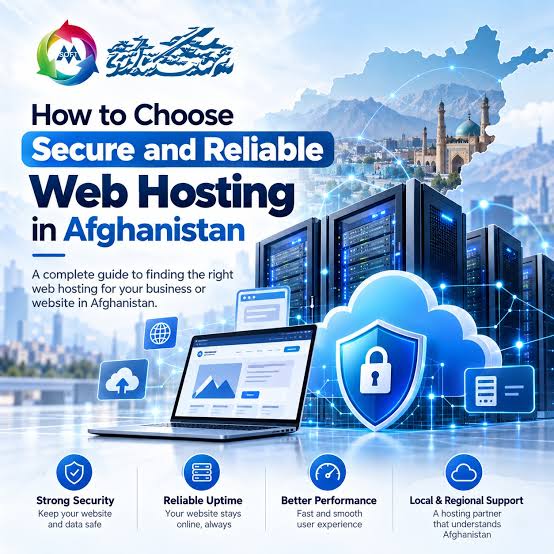
Choose Reliable Hosting: A Guide for Businesses in Afghanistan
If you want to build a professional website, you must choose reliable hosting. Your hosting provider affects website speed, security, and availability.
A poor hosting service can create problems for your business. Your website may become slow or unavailable. Customers may also lose trust in your company.
However, choosing a hosting provider does not need to be difficult. You only need to understand a few important features.
In this guide, you will learn how to compare hosting providers. You will also discover what to check before buying a hosting plan.
Why Is Choosing a Reliable Hosting Provider Important?
Your website represents your business online. Customers visit it to find information, explore services, and contact your team.
Therefore, your website should work properly.
A reliable hosting provider can help you:
- Keep your website available.
- Improve server response and website performance.
- Protect important website information.
- Create professional business email accounts.
- Recover website data through backups.
- Upgrade hosting as your business grows.
Good hosting does not solve every website problem. However, it provides an important foundation for your online business.
10 Things to Check Before Choosing a Hosting Provider
Do not select a hosting company based only on its advertised price. Compare the following features before making a decision.
1. Check Website Uptime
Uptime measures how long a website remains available online.
Some hosting providers advertise 99.9% uptime. However, you should also check their actual service terms.
Ask these questions:
- What uptime target does the company offer?
- How does it measure downtime?
- Does it provide a written service agreement?
- What happens when the server becomes unavailable?
A clear uptime policy helps you understand the provider’s responsibilities.
2. Check Website Speed
Website speed affects the visitor experience. Slow pages can make customers leave your website.
Before purchasing, ask about the hosting server and available resources.
Check these features:
- SSD or NVMe storage.
- Suitable CPU and memory resources.
- Server location.
- Supported PHP versions.
- Database performance.
- Caching options.
Also remember that website speed depends on more than hosting. Images, plugins, themes, and website code also matter.
3. Review Security Features
Security is important for every business website. Your website may contain customer information, contact forms, and business data.
Check whether the hosting provider offers:
- SSL certificates.
- Firewall protection.
- Malware scanning.
- Secure account access.
- Regular software updates.
- Protection against common attacks.
Also ask whether you can enable two-factor authentication for your hosting account.
4. Check Website Backup Options
Backups help you recover your website after unexpected problems.
For example, a plugin update may damage your website. A security incident may also affect your files or database.
Before choosing a plan, ask:
- Are backups automatic?
- How often are they created?
- How many backup copies are stored?
- Are website files and databases included?
- Can you restore a backup yourself?
- Are restoration services free?
Daily backups can be useful for business websites that change regularly. You should also keep an independent copy of important website data.
5. Test Customer Support
Good technical support can save your business time. You may need help with server errors, email problems, or website migration.
Check the available support channels.
For example:
- Phone support.
- Email support.
- Live chat.
- Support tickets.
- Technical documentation.
Do not trust a 24/7 support claim without checking its meaning. Ask whether technical staff are available around the clock.
You can also send a technical question before purchasing. This helps you evaluate the quality of the response.
6. Compare Hosting Prices
Hosting prices vary between providers. Some companies offer low introductory prices.
However, renewal prices may be higher.
Compare the complete cost before purchasing.
| Price Detail | What to Check |
|---|---|
| Initial price | How much do you pay first? |
| Renewal price | What will you pay next year? |
| SSL certificate | Is it included? |
| Backups | Are they included or paid? |
| Email accounts | How many accounts are available? |
| Migration | Is website transfer free? |
| Support | Is technical assistance included? |
Always ask for the final price in writing. This helps you avoid unexpected charges.
7. Choose the Right Hosting Type
Different websites need different hosting resources.
Choose a hosting type that matches your website.
Shared Hosting
Shared hosting is suitable for many personal and small business websites. It is usually an affordable starting option.
WordPress Hosting
WordPress hosting supports websites built with WordPress. Check the PHP version, database support, and available WordPress tools.
VPS Hosting
VPS hosting provides allocated server resources. It offers more control than standard shared hosting.
Dedicated Server Hosting
Dedicated hosting provides an entire physical server. It may suit large websites and demanding applications.
You do not need expensive hosting for every website. Start with a suitable package and upgrade when necessary.
8. Check Storage and Bandwidth Limits
Storage holds your website files, images, and databases. Bandwidth supports data transfer between your server and visitors.
Before purchasing, check the limits of your hosting package.
Do not select a plan based on the word “unlimited” alone. Ask about CPU, memory, file limits, and fair-use conditions.
A clear resource policy is more useful than an unclear unlimited offer.
9. Check Domain and Email Management
Some hosting providers also offer domain registration and business email services.
This can make website management easier.
However, make sure you control your domain registration account. You should also have access to your DNS settings.
For business email, ask whether the service supports SPF, DKIM, and DMARC. These settings help protect your domain’s email reputation.
10. Check Upgrade and Migration Options
Your business may grow over time. Your website may receive more visitors or require additional resources.
Choose a provider with a clear upgrade process.
Also, ask whether you can move your website to another hosting company. Check whether your files, databases, DNS records, and email can be transferred.
A good provider should make it possible to access and export your own website data.
Warning Signs of an Unreliable Hosting Provider
Some hosting offers look attractive but may create problems later.
Watch for these warning signs:
- No clear company contact information.
- No published hosting package details.
- Unclear renewal prices.
- No backup or restoration information.
- Unclear security responsibilities.
- No explanation of resource limits.
- Poor or unhelpful customer support.
- No clear website migration process.
If a provider cannot answer important questions before payment, consider another option.
Which Hosting Provider Should You Choose in Afghanistan?
If your business targets customers in Afghanistan, compare providers based on your website needs.
Check their hosting packages, technical support, payment options, and available services.
Also consider the location of the server. A server closer to your main visitors may help reduce network delay, although routing and server performance also matter.
Do not choose a provider only because its office is nearby. Technical quality and support are more important.
Why Consider MSoft Technologies?
MSoft Technologies provides web hosting, domain registration, and website development services.
Its website lists different hosting packages for customers with different website requirements.
Before purchasing, contact the team and discuss your website needs. Ask about the exact storage, bandwidth, backups, SSL, server resources, and support included in your selected plan.
You should also confirm the renewal price and any additional charges.
Contact MSoft Technologies
- Phone: +93 77 429 1300
- Email: info@msoft.af
- Address: House #4, Street #2, Near Kabul New York Furniture, Traffic Square, Kulula Pushta, Kabul, Afghanistan.
- Website: https://msoft-host.com/
Explore the available hosting services:
A Simple Hosting Provider Comparison Checklist
Before making your final decision, compare at least two or three providers.
Use this checklist:
- Does the provider offer suitable hosting for my website?
- Is the uptime policy clearly explained?
- Are backups included?
- Is SSL available?
- Are server resources clearly listed?
- Can I contact technical support?
- Are renewal prices available?
- Can I upgrade my hosting plan?
- Can I download or transfer my website data?
- Do I control my domain and DNS settings?
Choose the company that gives clear answers and meets your requirements.
Frequently Asked Questions
1. How do I choose a reliable hosting provider?
Compare uptime, speed, security, backups, support, and renewal prices. Also check whether the hosting plan supports your website technology.
2. What is the most important hosting feature?
There is no single feature for every website. However, availability, security, backups, and technical support are important for business websites.
3. Is cheap hosting reliable?
Affordable hosting can work well for small websites. However, check its resources, support, backup policy, and renewal price before buying.
4. How much uptime should a hosting provider offer?
Many providers advertise 99.9% uptime. Read the service agreement to understand its measurement method and exclusions.
5. Should I choose shared hosting or VPS hosting?
Shared hosting may suit small websites. VPS hosting offers more control and allocated resources. Choose based on your website’s actual requirements.
6. Can I change my hosting provider later?
Yes. You can move your website to another provider. Keep backups and test the new website before changing your domain’s DNS settings.
7. Does hosting affect website SEO?
Hosting can affect website speed and availability. These factors can influence the visitor experience and search performance. However, hosting alone does not guarantee better rankings.
Choose the Right Hosting for Your Website
Choosing a hosting provider is an important decision for your business. Do not focus only on the cheapest package.
Compare performance, security, backups, support, and renewal costs. Make sure the provider can support your website as it grows.
If you need web hosting for your business in Afghanistan, explore the available services from MSoft Technologies.
Visit https://msoft-host.com/ or call +93 77 429 1300 to discuss your requirements.
Choose a hosting plan that gives your website a reliable foundation.